I’m still working on the data analysis for my survey project, but I wanted to share some initial results. A brief recap of the project: I’m comparing the research priorities of marine managers and fishermen to those from a previously published survey of scientists (for more details, see my previous post). I sent 25 big questions in ocean research and management to hundreds of marine and coastal decisionmakers and stakeholders in the US, and had them complete a ranking exercise to prioritize the questions. By comparing their priorities to scientists’ priorities of those same questions, I can look for areas in which scientists might need to do a better job in communicating the importance of their work, or refocus toward an issue that managers and fishermen particularly care about.
The following is adapted from a report I sent out to survey participants, and I hope to have more formal, published results soon (although scientific time, I’m learning, tends toward geologic).
Who took the survey?
417 people completed the survey, and an additional 846 viewed or partially completed it. I limited my scope to managers and stakeholders in the United States, so three international respondents were removed for analysis.
I also had an astonishingly difficult time preventing scientists from taking the survey! The first page of the survey asked anyone employed as a research scientist to opt out, and yet I still had 63 respondents that put “scientist” or some form of “-ologist” in their primary job title. This is no doubt partially attributable to scientists’ difficulty in following directions, but it’s also harder to draw the line between scientist and stakeholder for those working outside academia. Even though many of these “sneaky scientists” may identify more as managers, I decided to omit them from my analysis since government scientists were included in the original survey, and I found that they did rank the questions significantly differently than the rest of the group. The following is based on my remaining sample of 351.
Region
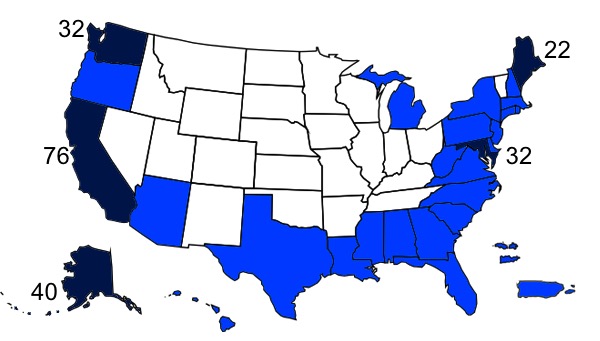
Respondents hailed from 30 states and territories, including Washington, DC. The numbers of respondents from the five states with highest participation are included below:
Gender
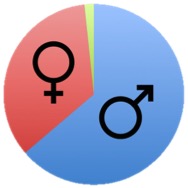
127 women and 217 men took the survey. 7 identified as “other” or declined to state.
text
text
Sector
Most respondents were employed in state government, likely due to the highest availability of state government email addresses online.
Top five priorities of scientists and stakeholders
I compared my results to only the North American subset of the original scientists (736 respondents), and their rankings of only the 25 questions I used in my survey. Many of the top questions are shared among groups, including among groups of stakeholders, below. I find this encouraging! Some of the key differences are that managers are more concerned with questions about bycatch (the accidental catch of non-target species, including endangered species like sea turtles or whales) and effectively restoring habitat–issues that they likely confront on a daily basis. Commercial fishermen and people employed in the seafood industry highly prioritize the inclusion of their local ecological knowledge in scientific understanding, while scientists ranked this #20 out of 25.

Top five priorities of stakeholders, by sector
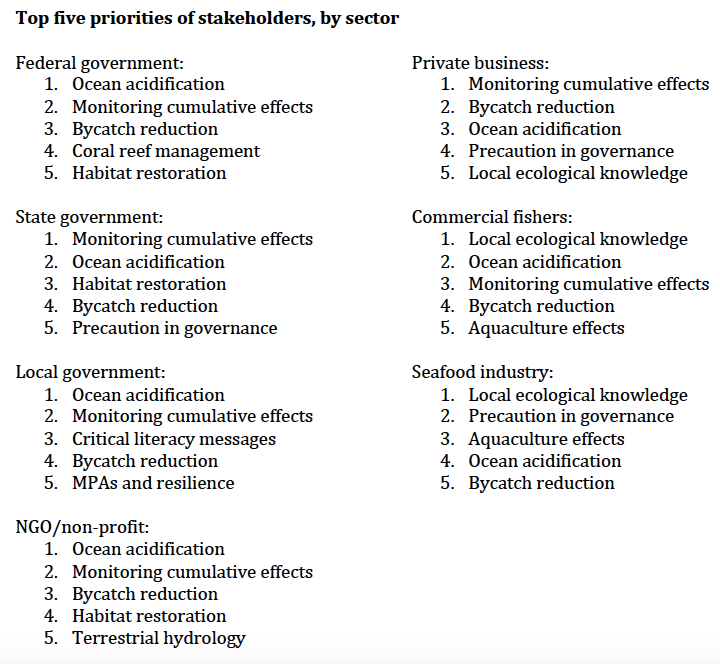 These results aren’t too surprising for anyone who has engaged in more applied or social science oriented work, but it’s exciting to have some numbers behind them. It looks like everyone is more or less on board about the big issues, but scientists could do a better job of focusing on policy-relevant issues related to fishing and habitat, and, most importantly, pay greater attention to what people who live and work with the oceans know through experience and observation. Once again, this requires a commitment to building trust and forming relationships, and it won’t happen overnight. After all the difficulty I had in getting fishermen to take the survey, I was amused to receive an email from a fisherman (in response to the report of results) expressing his disappointment that fishers were so underrepresented relative to government employees! I’m looking forward to continuing this analysis and improving my ability to engage stakeholders in relevant and useful research.
 A Drop in the Ocean