I was surprised to learn upon arriving in Peru that a major target of the small-scale fishery is shark. Shark fishing has gained some notoriety in recent years from the incredibly wasteful practice of shark finning, in which fishers (often illegally, often in developing countries) catch sharks by the hundreds, discard their carcasses, and sell the fins for premium prices to Asian markets, where they’re used in prestigious shark fin soup.
But the surprising part is that the Peruvian shark fishery isn’t about shark fins at all, it’s primarily for the direct human consumption of meat. Shark is consumed all across Peru in popular seafood dishes like ceviche, although it’s caught and sold under the name “tollo” or “toyo,” and most Peruvians have no idea they’re eating “tiburón.” Peruvian fishers do sometimes sell the fins and enjoy a nice financial bonus, and by the sheer size of the fishery Peru is a major supplier of shark fins, but it’s almost an afterthought. Most of the sharks that I saw in the markets still had all their fins intact. The fishers I talked to were scandalized that Americans don’t eat shark meat. “But you have a lot of sharks in California, no? And you don’t eat any of them?”

“Tollo” sold at the fish market in Santa Rosa. The fins are nearly always intact but often not the heads, which can make the sharks difficult to identify.
Why was this surprising to me? It’s not that I was balking at an unfamiliar food—having long ago crossed the cuy threshold and braved Palau’s fruit bat soup, I’m fairly culinarily unflappable. It’s that sharks are so widely recognized as crucial to marine ecosystems, and are in such heavy decline, that you rarely hear about shark fishing outside the high-risk high-reward finning industry, or as accidental catch (although a quick FAO search reveals that shark consumption is far more common than I realized). As I struggled to put into Spanish for the group of fishers two weeks ago, sharks are usually apex predators in marine ecosystems, meaning that they keep all the subsequent levels of the food chain in balance. It’s counterintuitive, but more sharks mean more fish: by preying on a large variety of fish, they prevent any one group from getting out of hand and unbalancing the system. Think of wolves, a terrestrial parallel. As we belatedly learned in Yellowstone National Park, rather than threatening elk populations, wolves keep them healthy by preying on old and sick elk, and thus prevent elk populations from overwhelming their food source. Sharks do the same thing in the oceans, thus actually promoting the abundance of commercially important species. An oft-cited example is that the decline of sharks along America’s mid-Atlantic coast released predatory pressure on cownose rays, which boomed and gobbled up all the shellfish, much to the chagrin of scallop fishers.
Unfortunately, sharks are slow-growing and slow-reproducing, and can’t keep up with the estimated 100 million that we’re taking each year. Sharks are increasingly coming under international protection in the face of steep population declines.
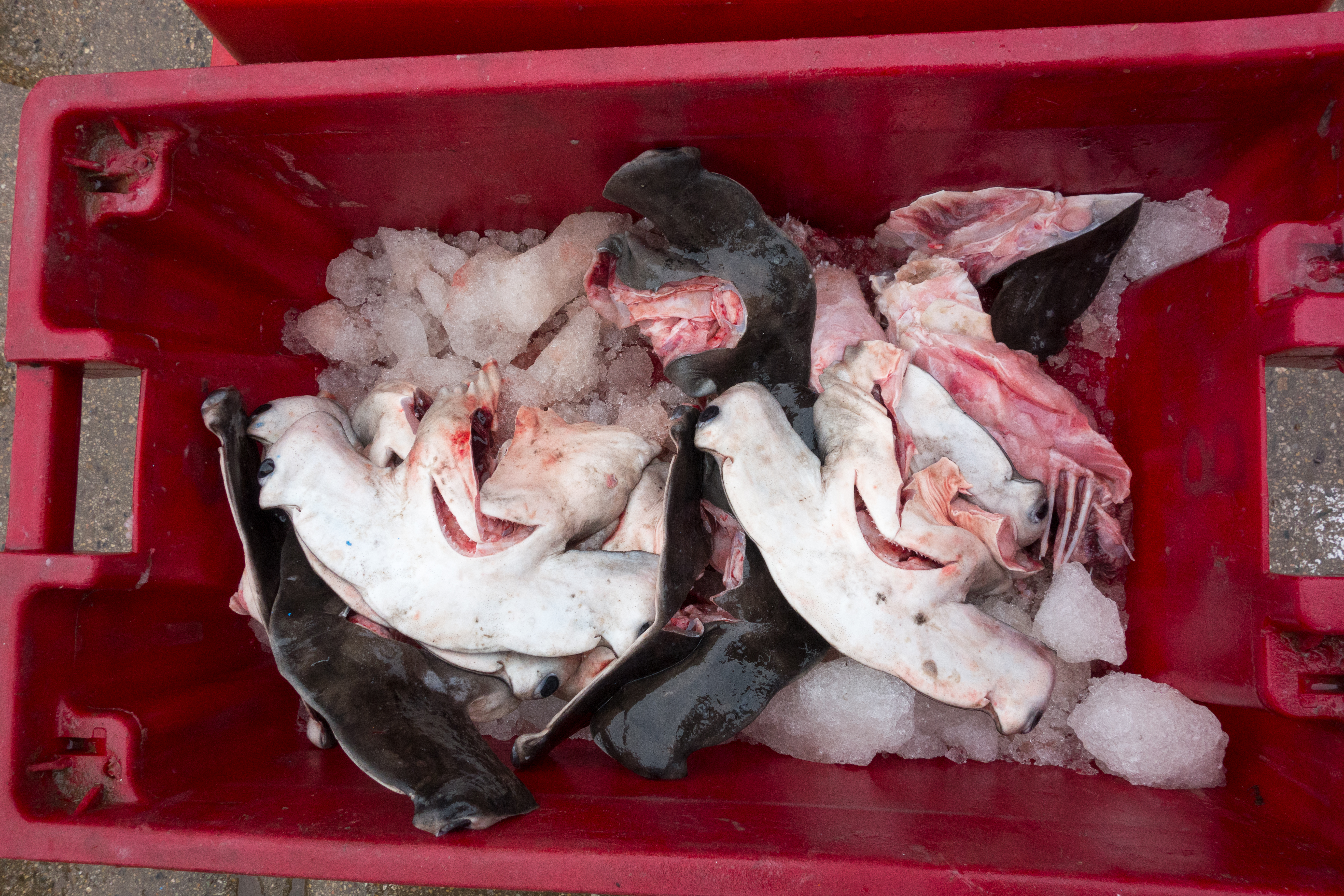
The scalloped hammerhead (Sphyrna zygaena) was listed under CITES in 2013.
Here’s the twist in the Peruvian shark fishery: it was in part introduced by the government and conservation NGOs in the late 1980s as a sustainability initiative. Sharks had long been targeted with gillnets (nets that hang vertically in the water), but these nets were also catching and killing a lot of dolphins. The Peruvian Ministry of Fisheries and a cetacean conservation agency workshopped shark longlining (as the name suggests, a long line with dozens to hundreds of suspended hooks) with fishermen, in an effort to save the dolphins and relieve pressure on dwindling fish stocks.
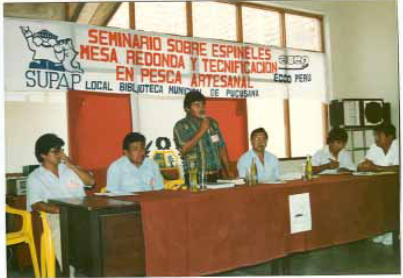
An image of a 1987 longline seminar in Pucusana (from a 1993 IUCN report by Julio Reyes)
Longlines are also notorious for their high rates of bycatch, so as a conservation biologist with “sharks = unsustainable; longlines= unsustainable” firmly etched into my brain, I was floored when I read this. I’m trying to get a better idea of how directly this initiative affected fishers and sharks–longlining has increased markedly here over the last few decades, but shark catches haven’t, likely due to fewer sharks combined with broader ecological or climatic influences. A thread I find particularly interesting is that in ProDelphinus interviews, fishers report first encountering and accidentally capturing critically endangered* leatherback sea turtles when they began fishing in the high seas, also in the late 80s. Was it the shift to longlining that brought artisanal fishers out to the high seas, or a broader decline in fished species closer to shore? Likely both. A definite unintended consequence of this policy, though, one dripping with irony, is that a popular type of bait for these shark longlines is dolphin meat.
I think this story is absolutely crazy. I have no idea how to feel about it. I certainly felt conflicted when I was presented with a plate of tollo ceviche my first day in San José! I definitely prefer the practice of using the whole shark as a protein source rather than slicing off just the fins, and many of our accepted seafood traditions are ecologically problematic—tuna, swordfish, and grouper are also important predators, for example. I attended an informational government meeting with fishermen about the shark fishery, and it’s clear that there’s a widespread lack of education about international endangered species laws and national size and catch restrictions at the fisher level, lack of awareness at the consumer level, and, the scourge of sustainable seafood initiatives everywhere, lack of traceability at every level of the supply chain. The use of dolphin meat for bait is truly unfortunate. A google search of “Peruvian shark fishery” yields incendiary accounts of The Cove-style butchery that, like many such fishery narratives, demonize fishermen as callous and greedy and put none of the accountability on the consumers and policies that impel the fishers’ choices. Restrictions or all-out bans are almost certainly in the future for Peruvian shark fisheries, but the consequences will be borne by these small-scale fishers who have nowhere else to turn.
*The IUCN classifies leatherbacks as vulnerable, and the East Pacific subpopulation as critically endangered.
Further reading:
- One of those hands-drawing-things videos about the importance of sharks
- How sharks (and wolves) also regulate ecosystems by sheer force of reputation
- A provocative and a more scientific account of the use of dolphins as bait
 A Drop in the Ocean