I spent my spring break in Washington DC for a whirlwind introduction to how science affects policy. I was one of twenty Stanford graduate students and postdocs from different departments who had applied to Stanford’s Rising Environmental Leaders Program (RELP), and a few months of meetings and communications training culminated in this “DC Boot Camp” to see firsthand how policy is developed and how to make our research relevant to politicians and the public.
Our five-day trip was crammed full of meetings and panels—lobbyists, congressional staffers, reporters, federal agency scientists, policy advisors, think tank directors. We heard from recent PhD graduates in year-long government fellowships and senior executives who had been in Washington for decades. We sat in on congressional budget hearings (including a particularly contentious grilling of the EPA’s Gina McCarthy), practiced our research “elevator pitches” with communications experts, and flexed our networking abilities. Some highlights were a special trip to the White House Executive Offices to meet with some of Obama’s advising team, and a talk from Dr. John Holdren, Assistant to the President for Science and Technology.
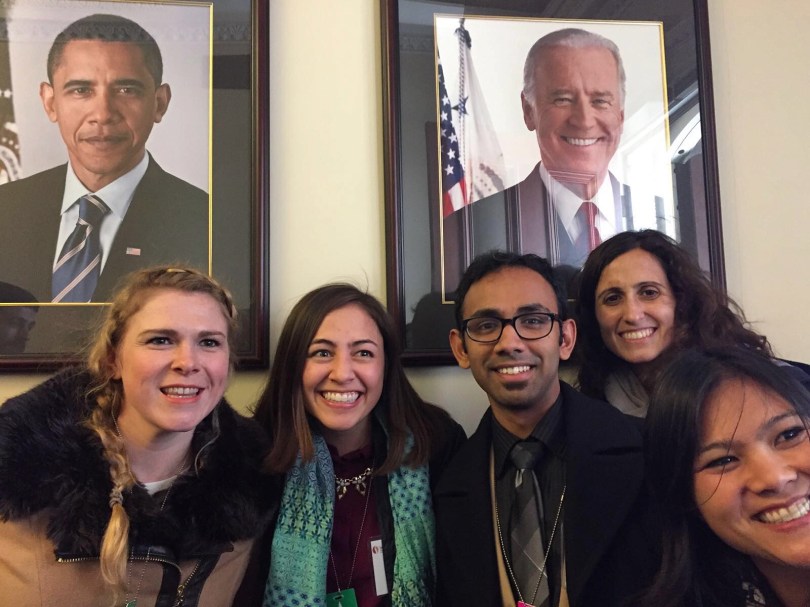
We were thrilled to visit the White House Executive Offices. The Obamas, unfortunately, were in Cuba.
It was, as everyone continually reminded us, a “fascinating/opportune/cataclysmic” time to be in DC, especially to hear the candid realities of jobs (or entire agencies) that evaporate after an election. It was also interesting to hear political science insights about how environmental politics have evolved at the national level—for example, it’s rare for major environmental legislation to pass while unemployment is high, and the polarization of climate change along party lines has occurred fairly recently, largely as a knee-jerk response to Obama’s policies. Unfortunately, this polarization has only solidified, and it might require a conservative but pro-environment president—a “Nixon in China” scenario—to get cohesive federal climate action. It was also fascinating and a trifle unsettling to hear political scientists and policy experts speculate about how social media and increasing economic disparity are radically changing our political process in ways they can’t understand or predict.
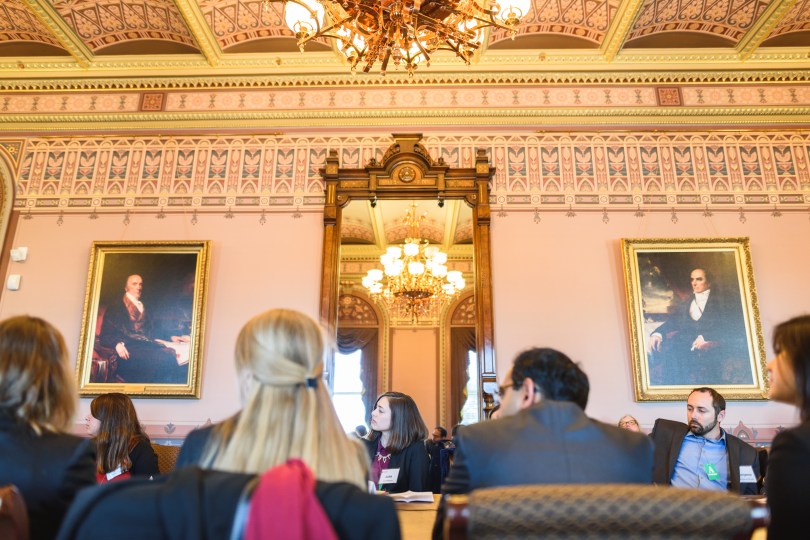
Our White House Executive Office panel took place in what is probably the grandest conference room I’ll ever enter. Photo courtesy of Stanford Woods Institute/Nathan Mitchell
On the whole, though, I emerged feeling hopeful. Many people emphasized that while gridlock in Congress means we won’t get national level change anytime soon, more nimble state legislatures, especially in California, are pioneering innovative and positive policies, and state and local level governments can have enormous influence. I was also inspired to see how many different ways science can make its way to policymakers—I’ve often deflected future career goal inquiries with hand wavy talk of the “science to policy interface,” and was excited to see the diversity of concrete career paths. I had felt frustrated that it seemed that you could only have an influence on real-world policy if you were a famous superstar senior professor. After this week, it’s clear that while it can certainly help to be a famous academic, policymakers rely far more on reputable non-profits and think tanks, federal science agencies like NOAA and USGS, and, very often, their staff. Unsurprisingly, congressmen aren’t delving into the primary literature–they don’t have journal access on the hill, much less the time and patience for dry scientific papers. Policy “windows” do open with majorities in the right places and a groundswell of public sentiment, and the best thing to do is be prepared with sound science and solid communications skills, and to jump at the opportunity.
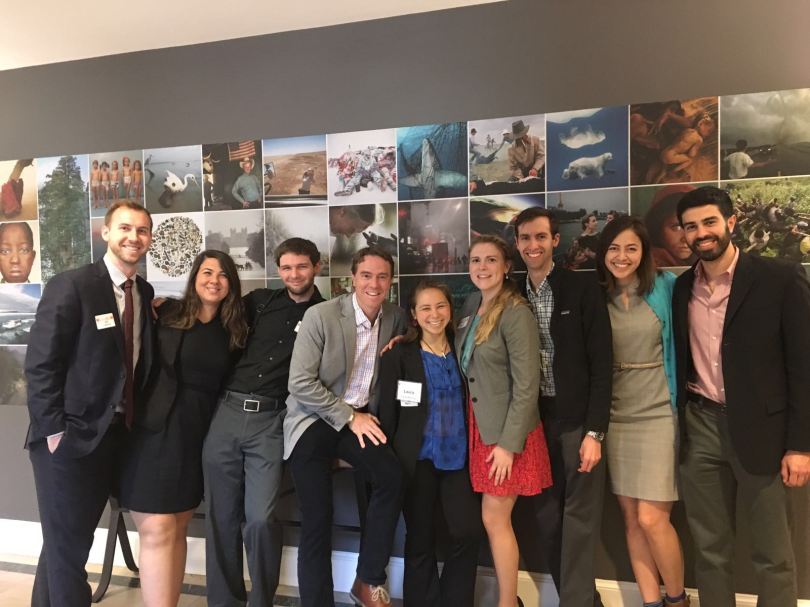
Our media panel brought us to the fabulous National Geographic offices.
Our week concluded with a celebratory lunch and remarks, and we were set free to revel in peak bloom of the cherry blossoms. I’m so glad I had this opportunity to experience the realities of policy and the diversity of possible careers, and most of all to meet the wonderful and inspiring group of people that were my fellow RELPers.
 A Drop in the Ocean