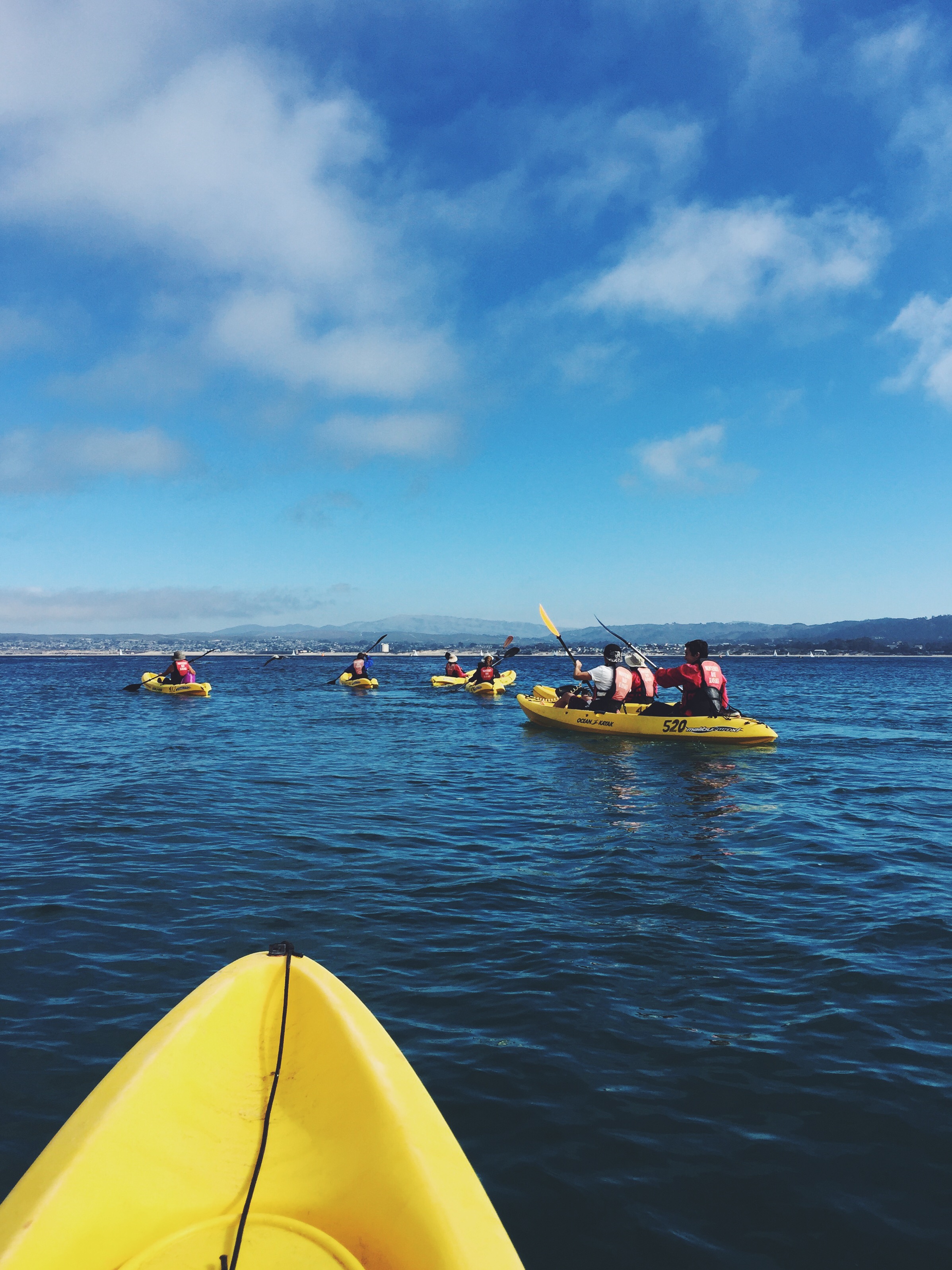
Over the weekend, I taught a course while kayaking in Monterey Bay. Stanford’s core undergrad Biology course allows grad students and postdocs to teach one-day elective “Explorations” courses on any biosciences subject we want, providing students exposure to specialized topics. When the call for teachers came out, I knew I wanted to teach one–students don’t often get a chance to see Hopkins Marine Station (where I work, Stanford’s marine biology outpost in Monterey, 90 miles down the coast from the main campus) without committing to spending a full quarter here, and student reviews indicated that these Explorations courses had inspired a lot of interest in marine biology and motivated several students to study at the station.
 I loved the idea of designing a course and am always eager for opportunities to indoctrinate young minds with love of the oceans and interest in conservation, but I was hesitant—I don’t study the local Monterey Bay system, and it hardly made sense to drag undergrads down the coast to spout off barely-formed ideas about Peruvian fisheries. I’m enthusiastic about communication and outreach but have been feeling that I have nothing to communicate: I don’t have a thesis topic and don’t feel like an expert in anything yet. But I’m realizing that my perception of “expert” is skewed by my dazzling peers and professors, and I shouldn’t pass up opportunities to share.
I’m interested in the power of storytelling in conservation, and liked the way Hopkins professor Steve Palumbi and Carolyn Sotka told the ecological and social history of Monterey Bay through the stories of its people in their 2011 book The Death and Life of Monterey Bay. The bay is famous for its swaying kelp forests, fantastic whale watching, and world-class aquarium, so it’s hard to imagine that just a few decades ago it was a smelly industrial dump. Monterey in the early and mid-20th century, Steinbeck’s Monterey, was a remarkably different place. Demand for oil had brought down the once-abundant whales. Sea otters had been declared extinct, heavily hunted for their luxurious fur. Sea urchin and abalone had boomed in the absence of the voracious sea otters, and completely eaten the kelp, before being heavily fished themselves. Without protective kelp cover, the diverse fish communities fled the bay, and with them their predators, harbor seals and sea lions. The entire bay was devoted to fishing and canning sardines, and fish offal and oil choked the water, the beaches, and the air. By the 1960s, the sardine fishery crashed under the combined influences of overfishing and broader climatic cycles, the decaying canneries and barren waters a testament to human greed.
But as much as the history of Monterey Bay is a cautionary tale of how human wastefulness ripples through the ecosystem, it’s also an inspiring message of how human actions foster recovery. I love the story of the indomitable Dr. Julia Platt, one of my new heroes. One of the first women to receive a PhD in zoology (in Germany, since turn of the century America wouldn’t award doctorates to women), she was repeatedly turned down for a faculty position at Hopkins, and settled for becoming the mayor of Pacific Grove. Julia was committed to saving the bay from the destruction she saw around her, and established a marine reserve in 1932 that now encompasses the Hopkins reserve that we dive in today. When the remnant population of sea otters that had been hiding in Big Sur ventured up the coast in the 1960s, they found abundant food in the reserve that supported their re-entry into the bay, and within years they brought the urchins under control and re-established the kelp forest ecosystem. Fish, seals, and whales came back, and public conservation spirit spurred by Rachel Carson and legislation like the 1972 Marine Mammal Protection Act helped them thrive in the bay.
The stories beautifully illustrate classic ecological concepts, and how human actions at the local and global level can both harm and help the environment. I thought they would be the perfect way to apply my ecology and conservation biology knowledge and my work with the link between humans and the environment to the Monterey ecosystem. My main goal was to bring students down to Monterey for a fun and interactive experience with the marine environment, and hopefully spark some interest in oceans conservation or research at Hopkins. And if I made it into a kayaking trip I would definitely have the coolest Explorations course, which was maybe actually my main goal.
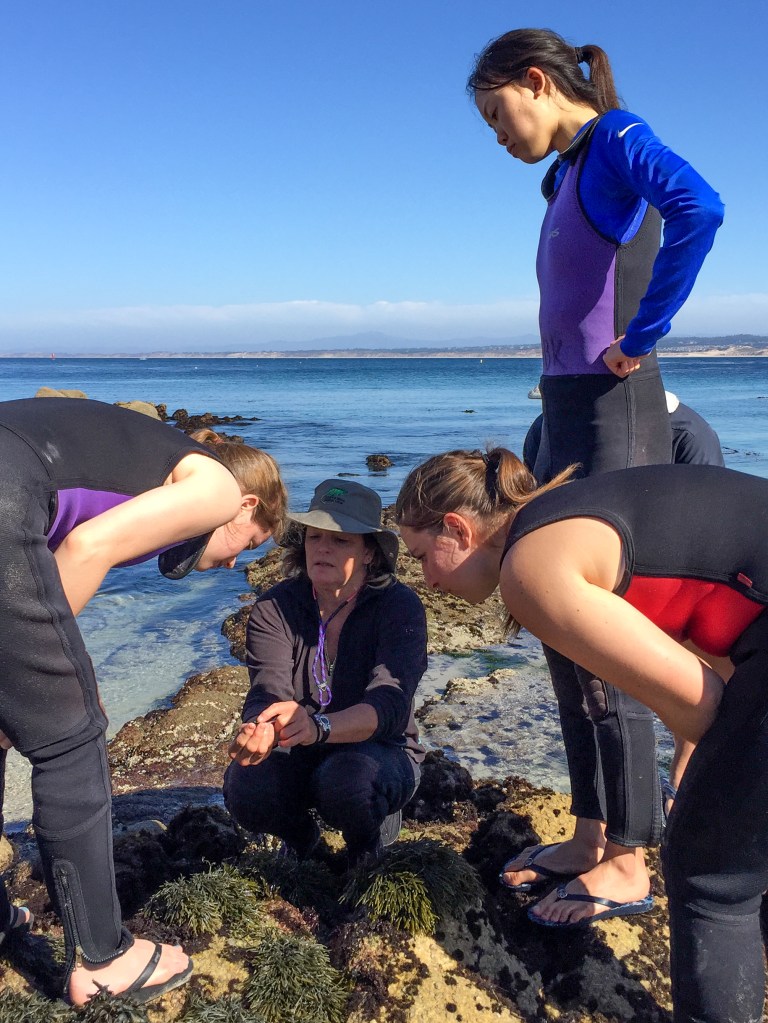
Freya shows off a hermit crab
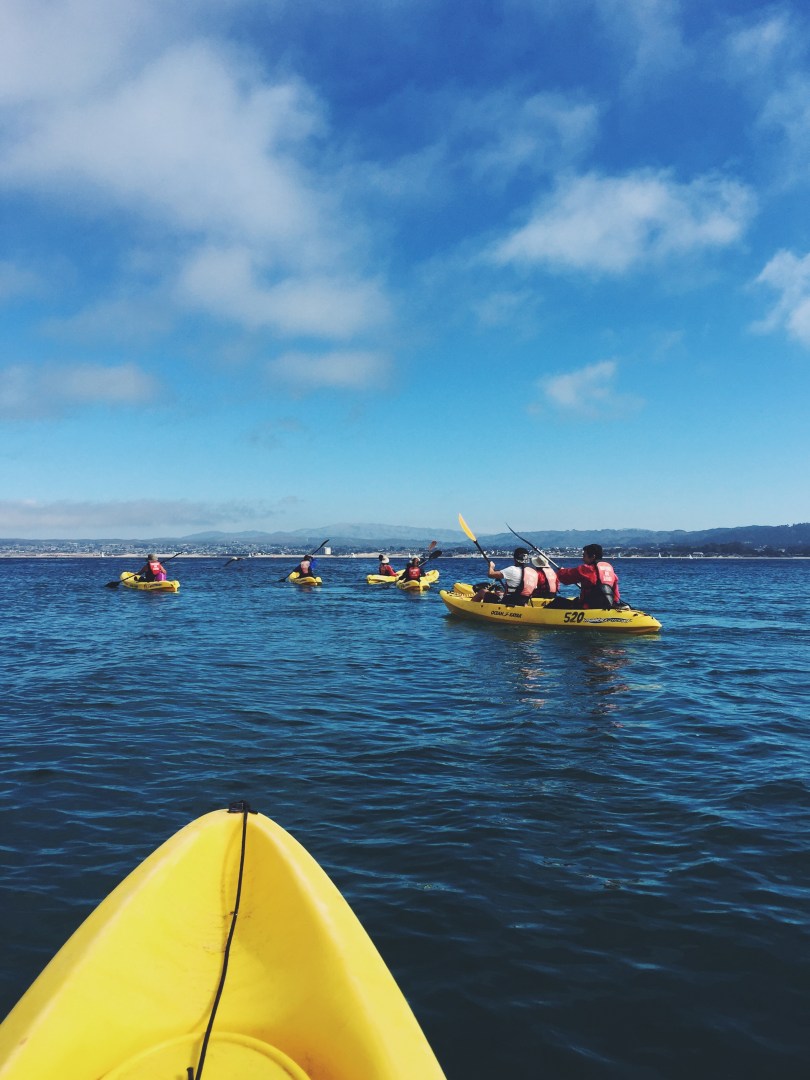
The kayaks were an awesome venue for telling these stories. While we stopped to watch a sea otter vigorously grooming itself (sea otters stay warm by trapping air bubbles in their thick fur, and also by eating up to 30% of their body weight each day—hence their dramatic food web impacts), I explained that otters are keystone species—they maintain and regulate the ecosystem and promote biodiversity, and when we remove them, there are major consequences all the way down the food web, called cascading trophic effects. As we drifted past the ruins of sardine canneries, I discussed how broad climatic cycles affect fisheries, perfectly punctuated by the school of anchovies that flashed beneath us, a signal of the coming El Niño. As we passed through the marine reserve on the way to a Hopkins beach for lunch, I talked about how individuals can make a difference through the marine reserve, with some anecdotes about the fiery Dr. Platt. I was very grateful that Freya Sommer, our dive safety officer, came along with me, not just to have help in case of any emergency, but also because she’s incredibly knowledgeable about the wildlife and ecology of the area. She came to the rescue for all the species identifications I didn’t know, and led a tidepooling expedition during lunch, a definite highlight.
I knew that the students were much more excited about kayaking than they were about discussing trophic cascades, and it was also more difficult than I anticipated to get everyone to raft together when I wanted to discuss something, so the course wasn’t as content-heavy as it could have been. But I think the students were thrilled to be out on the water on a beautiful day spotting sea otters and harbor seals—I certainly was—so I feel I achieved what I set out to do. I definitely think I achieved my coolest teacher goal—we were limited by van space to six students, and apparently the course filled within 5 seconds. I’m already looking forward to teaching it again next year!


 A Drop in the Ocean