Final days in Peru

I’m wrapping up my time in Peru, and looking forward to returning to the states in a few days. I have a ton to think about and a couple potential projects percolating: all in all it was a hugely useful and successful field session.

Unfortunately, Shellcatch, the sustainability certification company I’m hoping to collaborate with, rescheduled their visit for next month, but I went ahead with my pre-assessment surveys. I spent all of last week in San José interviewing fishermen and their families. Of course, it’s difficult to predict what the right questions will be before a project has started, but I thought it would be a good idea to get a sense of current rates of bycatch, flows of fish and money, and people’s attitudes toward their community, environment, and economic situation now, and track any changes as the certification project progresses.
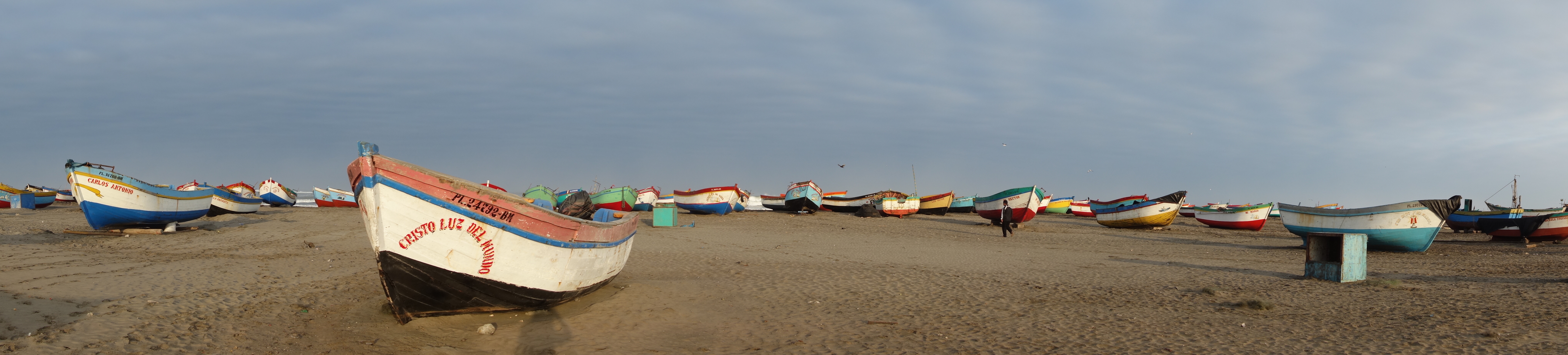
Brightly-colored "chalanas" bring fishers out to their bigger boats anchored offshore: one of many components of the fishing economy in San José.

Brightly-colored “chalanas” bring fishers out to their bigger boats anchored offshore: one of many components of the fishing economy in San José.


I also asked questions about the role of women in the fishery and in the community, because I was interested, because women, as an integral part of the community and economy, also stand to be impacted by the Shellcatch project, and also because ProDelphinus is waiting to hear back from a grant to fund a women’s education and empowerment program. In order to run an effective program, it would first be helpful to better understand how the women are acting in the community, and what their needs are. I’m hopeful that the grant goes through, since educating women is arguably the most powerful environmental (and economic, and social, you name it) intervention possible.

I thought I’d get a chance to interview maybe 20 or 30 people at most, but after a whirlwind week I returned to Lima with 58 completed surveys! I had the incredible good fortune of working with David Sarmiento, a government official who collects fisheries landings data. He was born and raised in San José and can not only greet every single person in the town by name, but also instantly recall everything about their fishing habits, down to the scientific species names. He’s a beloved and respected figure throughout the town, and just being associated with him meant that people were happy to talk to me. Minutes after his introduction, people I hadn’t even met before welcomed me into their homes, plied me with food and gifts, and chatted candidly about their bycatch, fish prices, and difficulties with the powers that be. I’m going to be completely spoiled for all future survey work.
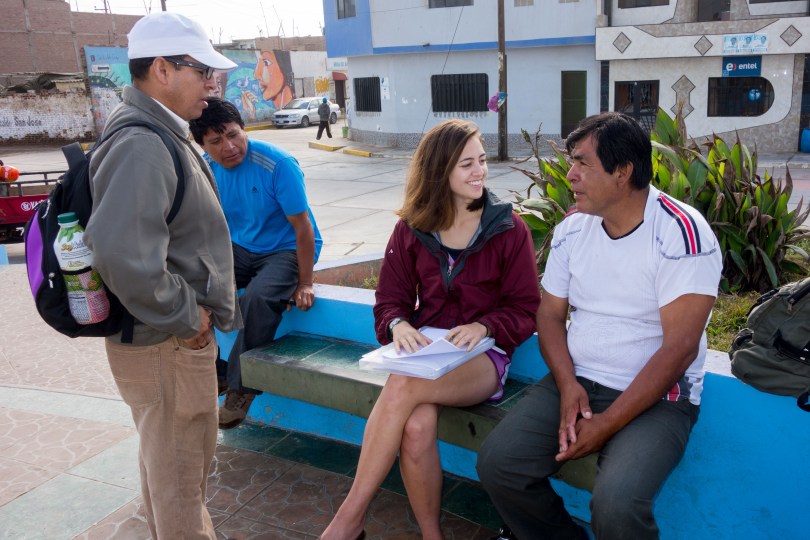
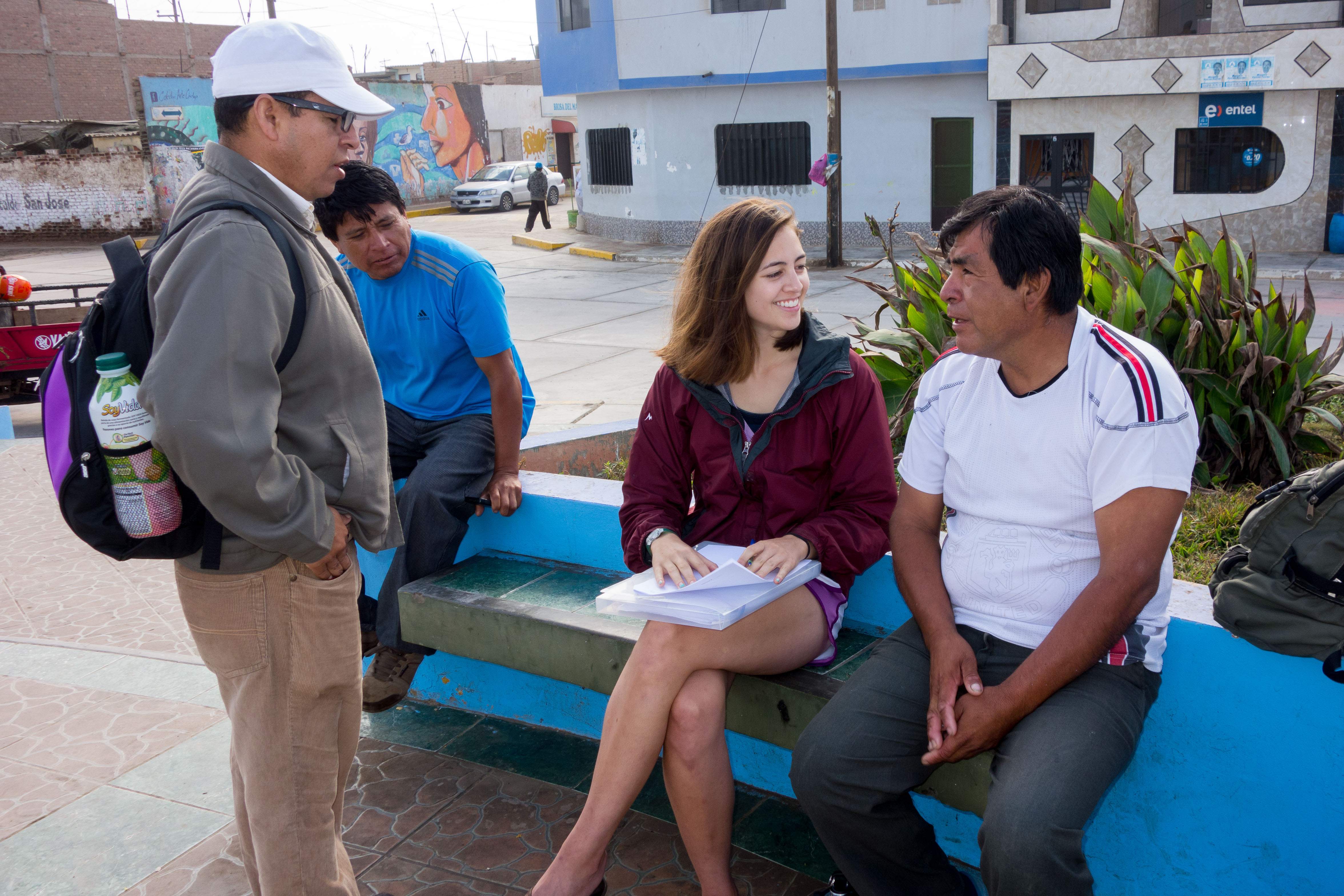
David (in the hat) was irreplaceable in his help in introducing me to interviewees and explaining some of their responses if they spoke too quickly!

My results are a basis waiting for future comparison, but I did learn a ton. For example, I had expected that women would primarily participate in the fishery and therefore economy by processing and selling their husbands’ fish. And, yes, most of them do. But I was surprised to learn that in addition, almost every woman that grows up in San José also learns several types of artwork—painting, cross stitch, embroidery, crochet. I was further surprised that during lean fishing times (which are common in Peru, because El Niño creates so much variability), rather than the men seeking other jobs, it’s the women that step up and sell their artwork, or sell their cooking. In studies of community resilience (the ability to withstand shocks or disruptions, like a big El Niño event), women are generally depicted as vulnerable victims, a marginalized group that loses out when shifts occur in the community. Not so here: the women seem to be a source of resilience! They are the ones that sustain their families in whatever way they can while their husbands, fathers, and sons wait for work, at the mercy of an unpredictable environment and a declining resource.
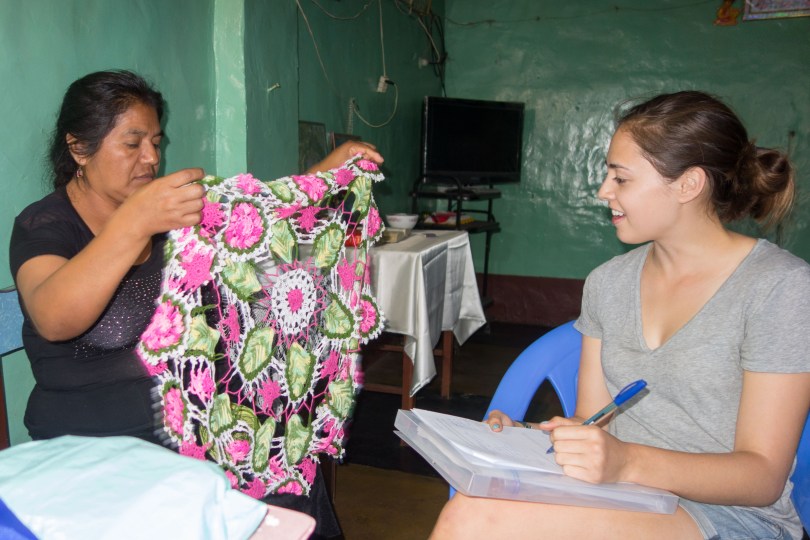
This woman showed me some of her beautifully detailed crochet work.

As always, the situation is complex, with intricate economic and social relationships within the community as well as with the government, broader market structure, and industrial fishery–I have a lot of information to take home with me and process over the next weeks and months. Many of the fishermen expressed eagerness to learn about how to improve their fishing methods, and how to avoid entangling turtles and mammals, primarily because they pose a threat to their expensive fishing gear (and, in the case of whales, their boats and lives), but some also expressed affection and a sense of stewardship for the “animalitos.” As for the women, they’re eager to find a way to export their artwork to broader markets, and expressed interest in education in nutrition, talking to their daughters about sex (it’s not uncommon to see girls pregnant at 14), and household accounting.

Interviews on the fly: tables and chairs weren’t always an option–I interviewed this fisherman in his “mototaxi.”

I’m overwhelmed with gratitude at the generosity and kindness of everyone I worked with, and am eager to return. When I asked one older fisher if he had any additional comments or questions, he looked at me and said, “I want for you to finish your studies. And I want for you to then come back, and to help us.” That’s exactly what I plan to do.
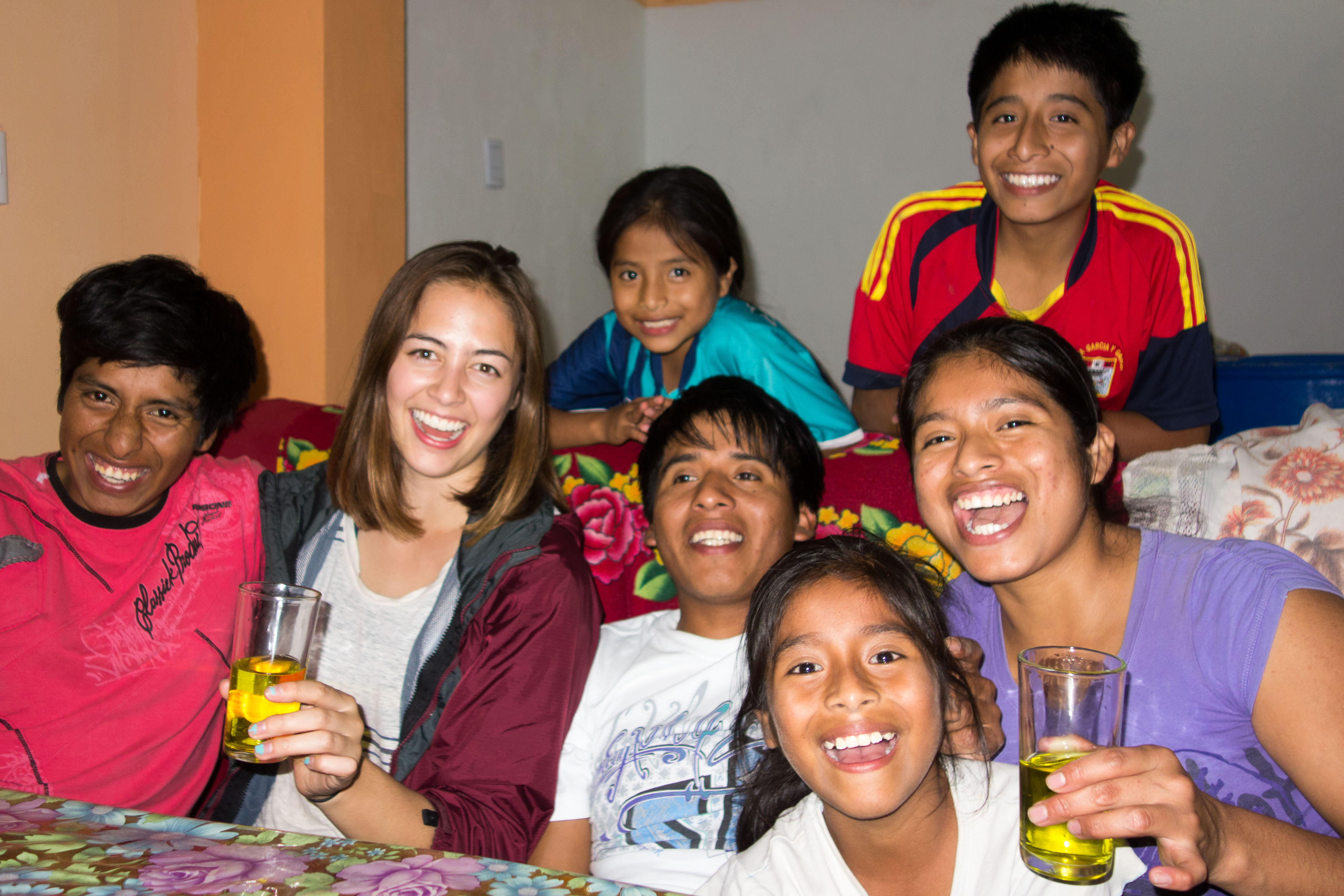
People welcomed me into their homes and into their families! I spent my evenings goofing off with this bunch and teaching them some English.

Mil gracias also to David, and everyone at ProDelphinus, especially Joanna and Jeff, and my wonderful field assistants Sergio, Astrid, and Diego. Nos vemos pronto!

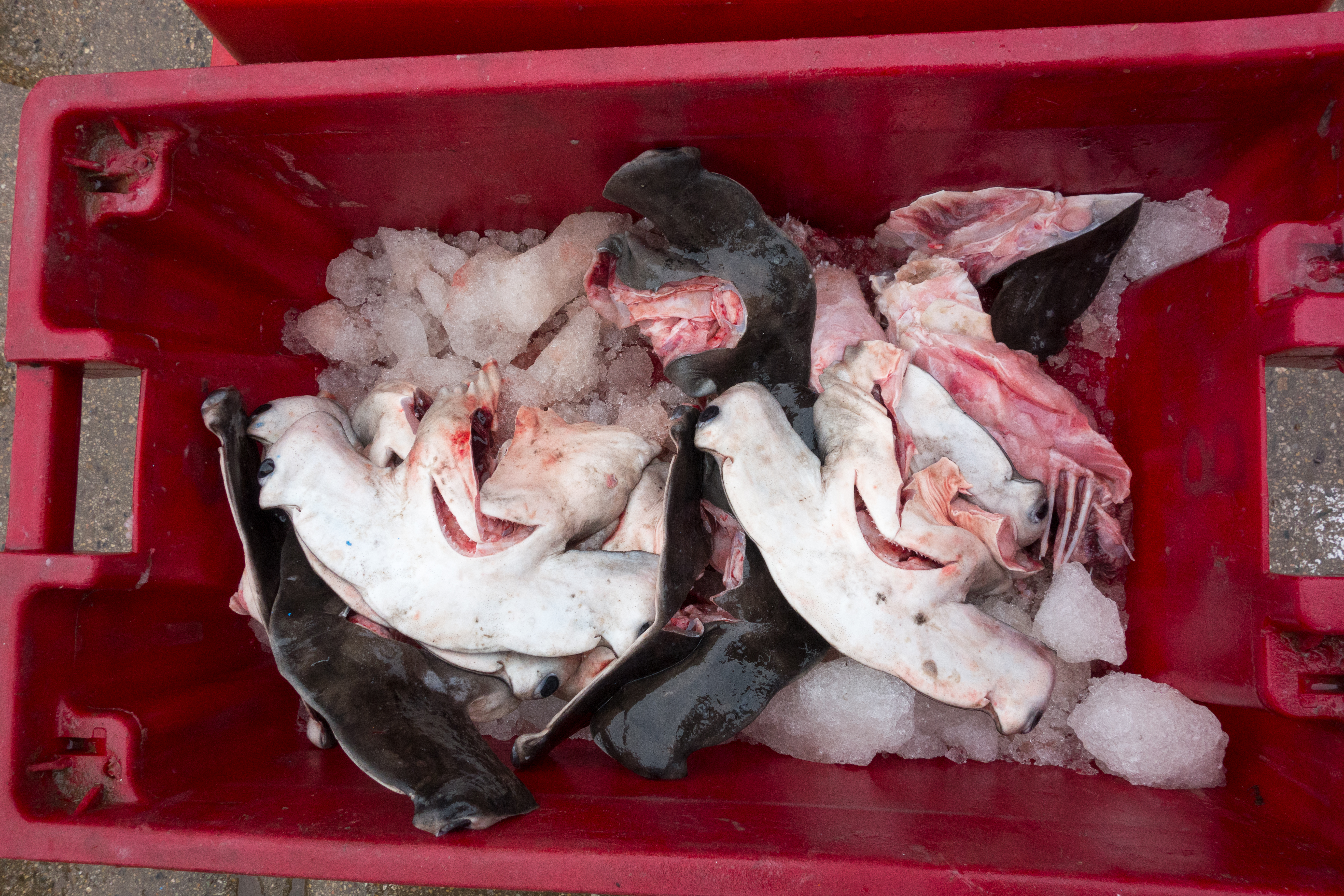
Peru’s Shark Fishery

I was surprised to learn upon arriving in Peru that a major target of the small-scale fishery is shark. Shark fishing has gained some notoriety in recent years from the incredibly wasteful practice of shark finning, in which fishers (often illegally, often in developing countries) catch sharks by the hundreds, discard their carcasses, and sell the fins for premium prices to Asian markets, where they’re used in prestigious shark fin soup.

But the surprising part is that the Peruvian shark fishery isn’t about shark fins at all, it’s primarily for the direct human consumption of meat. Shark is consumed all across Peru in popular seafood dishes like ceviche, although it’s caught and sold under the name “tollo” or “toyo,” and most Peruvians have no idea they’re eating “tiburón.” Peruvian fishers do sometimes sell the fins and enjoy a nice financial bonus, and by the sheer size of the fishery Peru is a major supplier of shark fins, but it’s almost an afterthought. Most of the sharks that I saw in the markets still had all their fins intact. The fishers I talked to were scandalized that Americans don’t eat shark meat. “But you have a lot of sharks in California, no? And you don’t eat any of them?”

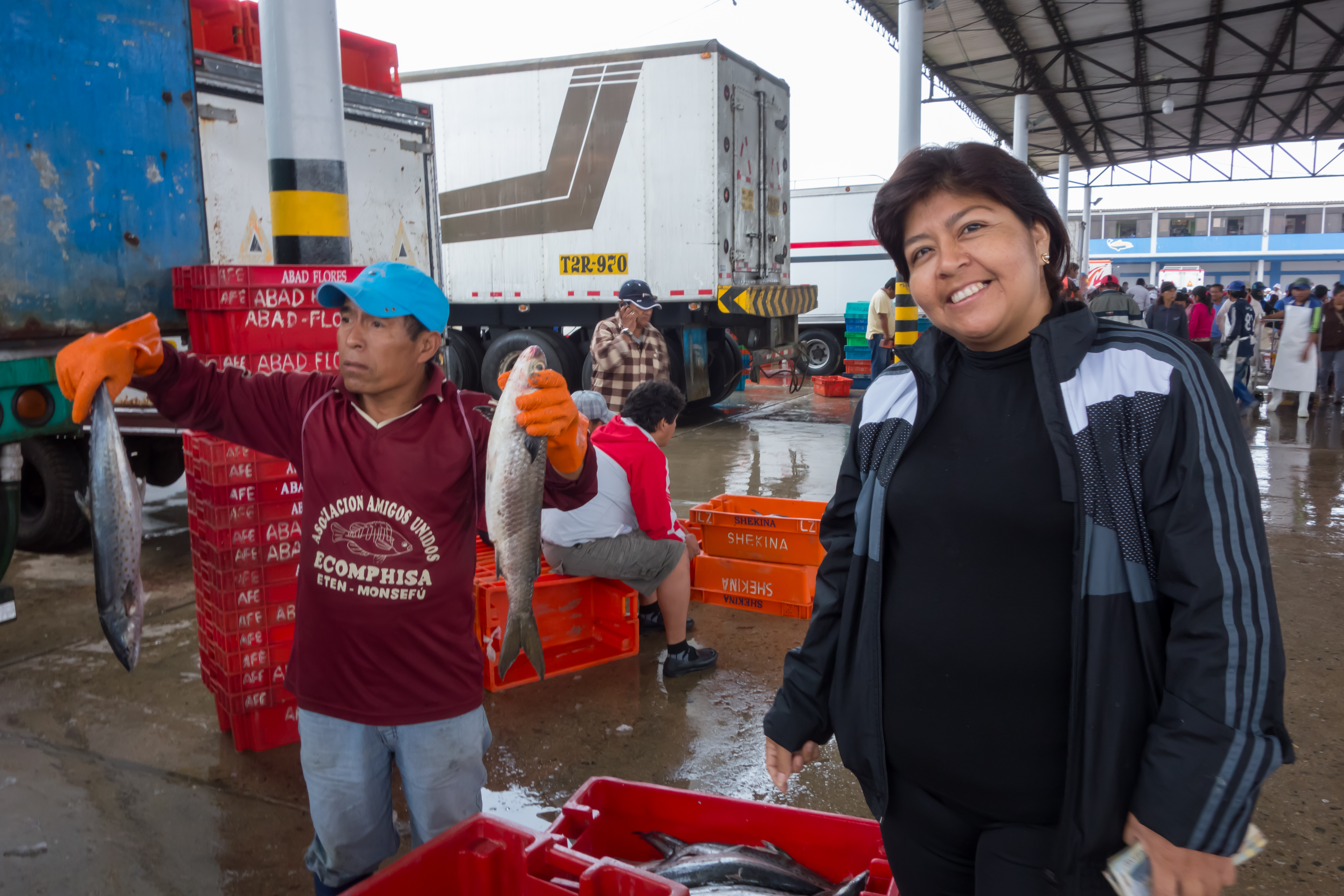
"Tollo" sold at the fish market in Santa Rosa. The fins are nearly always intact but often not the heads, which can make the sharks difficult to identify.

“Tollo” sold at the fish market in Santa Rosa. The fins are nearly always intact but often not the heads, which can make the sharks difficult to identify.

Why was this surprising to me? It’s not that I was balking at an unfamiliar food—having long ago crossed the cuy threshold and braved Palau’s fruit bat soup, I’m fairly culinarily unflappable. It’s that sharks are so widely recognized as crucial to marine ecosystems, and are in such heavy decline, that you rarely hear about shark fishing outside the high-risk high-reward finning industry, or as accidental catch (although a quick FAO search reveals that shark consumption is far more common than I realized). As I struggled to put into Spanish for the group of fishers two weeks ago, sharks are usually apex predators in marine ecosystems, meaning that they keep all the subsequent levels of the food chain in balance. It’s counterintuitive, but more sharks mean more fish: by preying on a large variety of fish, they prevent any one group from getting out of hand and unbalancing the system. Think of wolves, a terrestrial parallel. As we belatedly learned in Yellowstone National Park, rather than threatening elk populations, wolves keep them healthy by preying on old and sick elk, and thus prevent elk populations from overwhelming their food source. Sharks do the same thing in the oceans, thus actually promoting the abundance of commercially important species. An oft-cited example is that the decline of sharks along America’s mid-Atlantic coast released predatory pressure on cownose rays, which boomed and gobbled up all the shellfish, much to the chagrin of scallop fishers.

Unfortunately, sharks are slow-growing and slow-reproducing, and can’t keep up with the estimated 100 million that we’re taking each year. Sharks are increasingly coming under international protection in the face of steep population declines.

The scalloped hammerhead (S. zygaena)  was listed under CITES in 2013.

The scalloped hammerhead (Sphyrna zygaena) was listed under CITES in 2013.

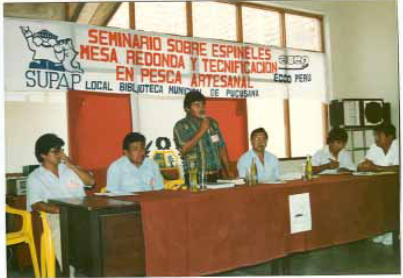
Here’s the twist in the Peruvian shark fishery: it was in part introduced by the government and conservation NGOs in the late 1980s as a sustainability initiative. Sharks had long been targeted with gillnets (nets that hang vertically in the water), but these nets were also catching and killing a lot of dolphins. The Peruvian Ministry of Fisheries and a cetacean conservation agency workshopped shark longlining (as the name suggests, a long line with dozens to hundreds of suspended hooks) with fishermen, in an effort to save the dolphins and relieve pressure on dwindling fish stocks.

An image of a 1987 longline seminar in Pucusana (from a 1993 IUCN report by Julio Reyes)

An image of a 1987 longline seminar in Pucusana (from a 1993 IUCN report by Julio Reyes)

Longlines are also notorious for their high rates of bycatch, so as a conservation biologist with “sharks = unsustainable; longlines= unsustainable” firmly etched into my brain, I was floored when I read this. I’m trying to get a better idea of how directly this initiative affected fishers and sharks–longlining has increased markedly here over the last few decades, but shark catches haven’t, likely due to fewer sharks combined with broader ecological or climatic influences. A thread I find particularly interesting is that in ProDelphinus interviews, fishers report first encountering and accidentally capturing critically endangered* leatherback sea turtles when they began fishing in the high seas, also in the late 80s. Was it the shift to longlining that brought artisanal fishers out to the high seas, or a broader decline in fished species closer to shore? Likely both. A definite unintended consequence of this policy, though, one dripping with irony, is that a popular type of bait for these shark longlines is dolphin meat.

I think this story is absolutely crazy. I have no idea how to feel about it. I certainly felt conflicted when I was presented with a plate of tollo ceviche my first day in San José! I definitely prefer the practice of using the whole shark as a protein source rather than slicing off just the fins, and many of our accepted seafood traditions are ecologically problematic—tuna, swordfish, and grouper are also important predators, for example. I attended an informational government meeting with fishermen about the shark fishery, and it’s clear that there’s a widespread lack of education about international endangered species laws and national size and catch restrictions at the fisher level, lack of awareness at the consumer level, and, the scourge of sustainable seafood initiatives everywhere, lack of traceability at every level of the supply chain. The use of dolphin meat for bait is truly unfortunate. A google search of “Peruvian shark fishery” yields incendiary accounts of The Cove-style butchery that, like many such fishery narratives, demonize fishermen as callous and greedy and put none of the accountability on the consumers and policies that impel the fishers’ choices. Restrictions or all-out bans are almost certainly in the future for Peruvian shark fisheries, but the consequences will be borne by these small-scale fishers who have nowhere else to turn.

*The IUCN classifies leatherbacks as vulnerable, and the East Pacific subpopulation as critically endangered.

Further reading:

Field Notes: Peru

I’m now two weeks into a six-week scoping trip in Peru, traveling around, chatting to people, and trying to make sense of the small scale fisheries here. The idea behind this trip is that no matter how much you read about a place or system, it’s difficult to know what’s truly going on and what the relevant questions are without being there to see it, poke around, and talk to people. Also, just as with the fishermen in my survey, the fishers here know way more about this ecosystem and fishery than I do, and my main goal for this trip is to build those incredibly important trust relationships by getting to know some fishers here and listening to what they have to say.

I’ve been reading extensively about Peruvian fisheries and have some ideas of what I’m looking for, but I’m mostly keeping my eyes, ears, and mind open. The importance of these “kicking the tires” expeditions is widely acknowledged, but I’m still very lucky to have an advisor who is so supportive of such an endeavor!

Lima

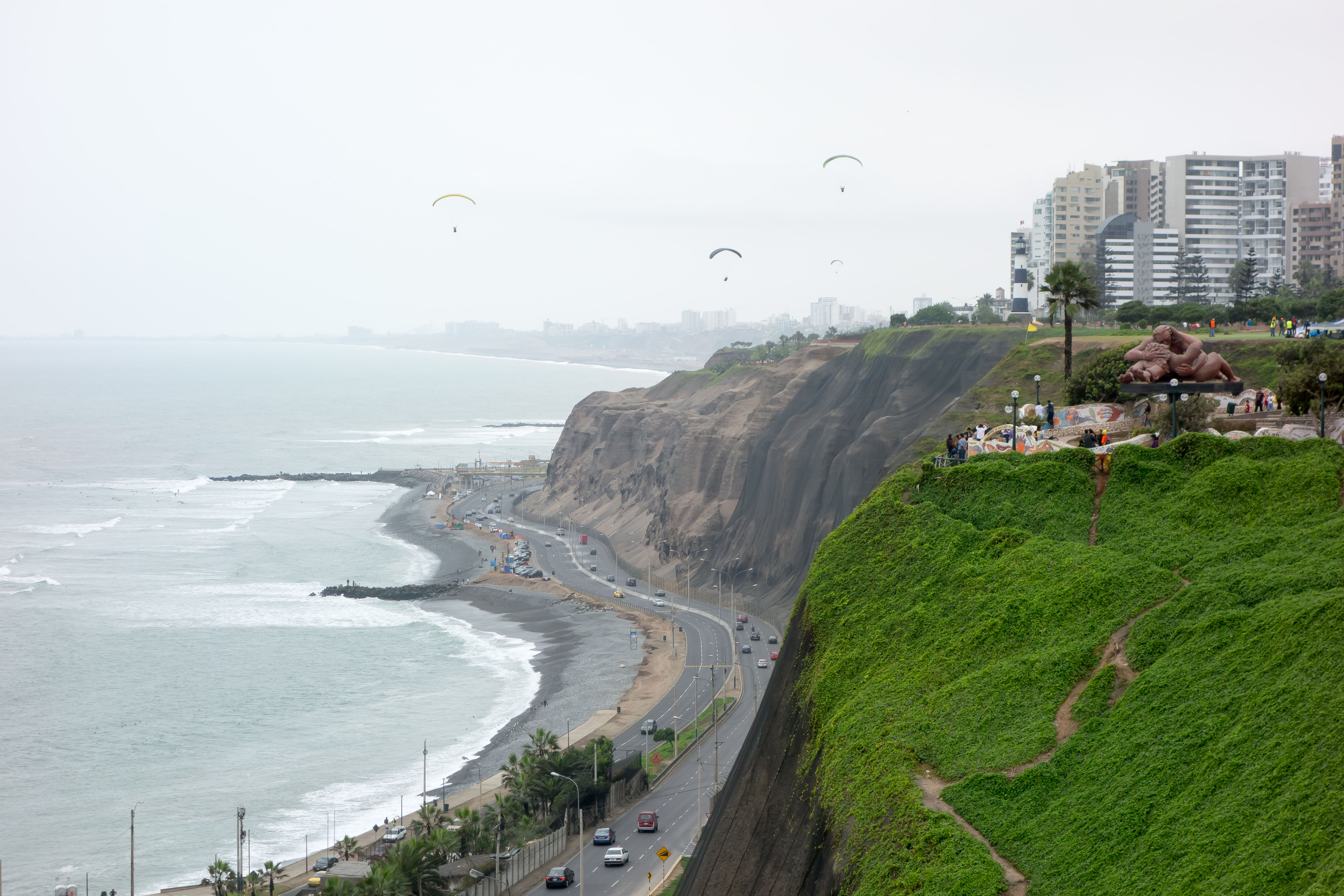
Lima’s cliffed coastline

I’m also lucky to have the help and support of people that know the area and the fishermen. I’m working with Pro Delphinus, a Lima based non-profit that works with fishermen to reduce bycatch (accidental catch) of turtles, mammals, and birds. Co-coordinators Joanna Alfaro and Jeff Mangel have both worked closely with my advisor, so he was tickled when I came to him with their papers and outlined my plans for a Peru trip.

They’ve done wonderful and extensive work with small scale fishermen all over Peru, teaching them how to identify and free animals that get tangled in their nets, and providing them with deterrents like lights and sound-emitting pingers. The fishers are eager to participate because bycatch is a huge problem for them: a net lost to a whale entanglement costs over a thousand dollars to replace, money they don’t have.

I spent my first week in the Pro Delphinus office in Lima learning about the different projects they’re working on and the types of data they have. I’m extremely excited by what they’re working on. Peru’s fisheries are a big deal: it’s the world’s second largest producer of fish behind China, but the focus has been on the industrial anchovy fishery, nearly all of which is exported as fish meal and fish oil. The artisanal fisheries, largely neglected in the literature (except by Joanna and Jeff), are a major source of employment, and the fish is eaten here, representing over a quarter of Peru’s animal protein consumption. But Peru’s extraordinary productivity also means it’s a hotspot for other species, including endangered and/or charismatic ones like sea turtles and whales. Small scale fisheries in Peru are a huge source of mortality for these animals, comparable to industrial scale fisheries. What’s particularly impressive is that Pro Delphinus works with fishermen rather than against them, providing them with experimental solutions and soliciting and incorporating the fishers’ feedback.

Pro Delphinus also works with Tasa, one of the largest industrial fishing companies in Peru. We joined Tasa fishers and administrators in an annual philanthropy event, planting trees at a local school.

Pro Delphinus also works with Tasa, one of the largest industrial fishing companies in Peru. We joined Tasa fishers and administrators in an annual philanthropy event, planting trees at a local school.

My original thoughts were to come here and get a better idea of the communities in which Pro Delphinus works. There’s scant literature on the social aspects of the artisanal fishery–who are these fishers? Have they always lived here or, as is increasingly common, are they migrants resorting to fishing following agricultural failures? What are the women doing? Peru is also dominated by El Niño (periodic El Niño-induced crashes in the Peruvian industrial anchovy fishery are the textbook example used to illustrate El Niño’s ecological impacts), and I’m interested in how this plays out ecologically and socially in the small scale fishery. How do both the ecosystem and the fishers adapt? It’s an El Niño year, so I thought this would be particularly relevant.

Unsurprisingly, from the moment I got here everything has been in flux, and I’m constantly learning new things and reevaluating my ideas. I couldn’t be happier to have this opportunity be flexible and open minded, and that I didn’t spend months preparing something specific but misguided. I think I’m even going to renege on my vow not to collect any data (“DON’T!” wailed an anthropologist I consulted before the trip. “Don’t even go in with a set list of questions! This should be like dating–just have a conversation!”). It turns out that Pro Delphinus has an upcoming project with Shellcatch, a San Francisco company, to give a sustainability certification (like the MSC certification I hope you look for in your seafood products; it’s similar to fair trade, but for being environmentally friendly) to some of their fishers in San José, a village in the north. Over the past few months I’ve become increasingly interested in certification programs like these, and what it means to eat sustainably in our global society (lengthy musings I’ll save for a future post).

 I think it would be awesome to follow this project over the next few years and see what happens in the environment and in the community. I have an opportunity now, on this trip, to do a baseline assessment before anything has started, so I can have a basis for future comparison. I’ve written up a little survey that I hope to trot out in the upcoming weeks, and reached out people from Shellcatch, who have expressed interest in working with me, and possibly meeting if they make it down while I’m here. I’m trying not to let myself get too excited (COULD THIS BE MY THESIS?!) before I talk to Shellcatch, but this could be really fun and interesting if it pans out!

San José

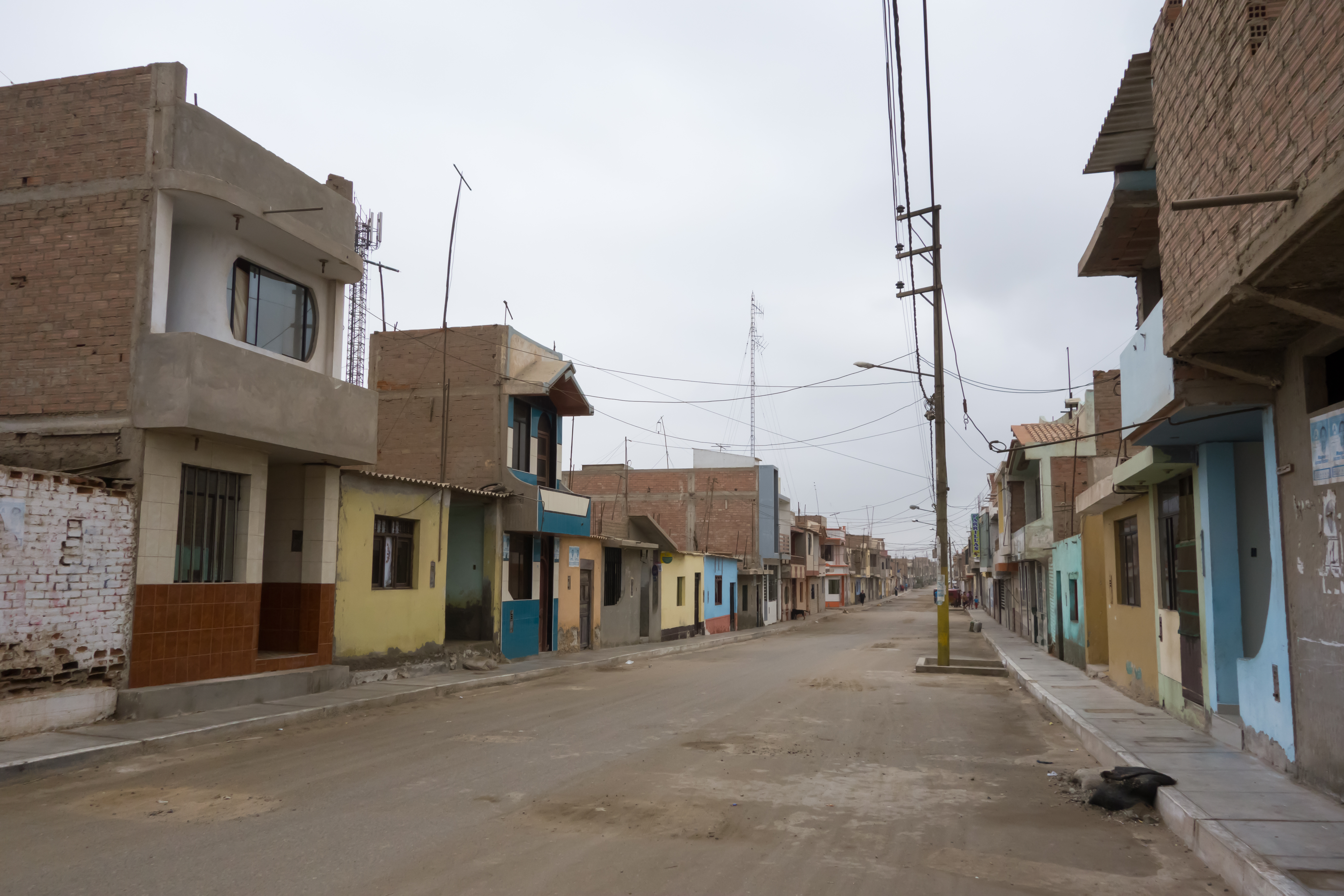
San José

I’m not, however, giving up my commitment to “people first, science second.” I spent the last week in San José chatting with the fishers and their families. It’s been so much to take in (compounded by my slowly returning high school Spanish skills), but I’ve had the wonderful and very patient help of Sergio and Astrid, of Pro Delphinus’s northern office. They first had a meeting with the fishers to distribute pingers and show videos of how to resuscitate tangled turtles, and I had the opportunity to give an introductory presentation about myself and my work, followed by a spirited question and answer session. I wasn’t expecting to cover such topics as the mechanical intricacies of the California purse seine fishery equipment usage or why sharks are important to ecosystems, but I think I did a passable job (the latter is more my area of expertise; I responded to the former with a lot of “yo no sé”).

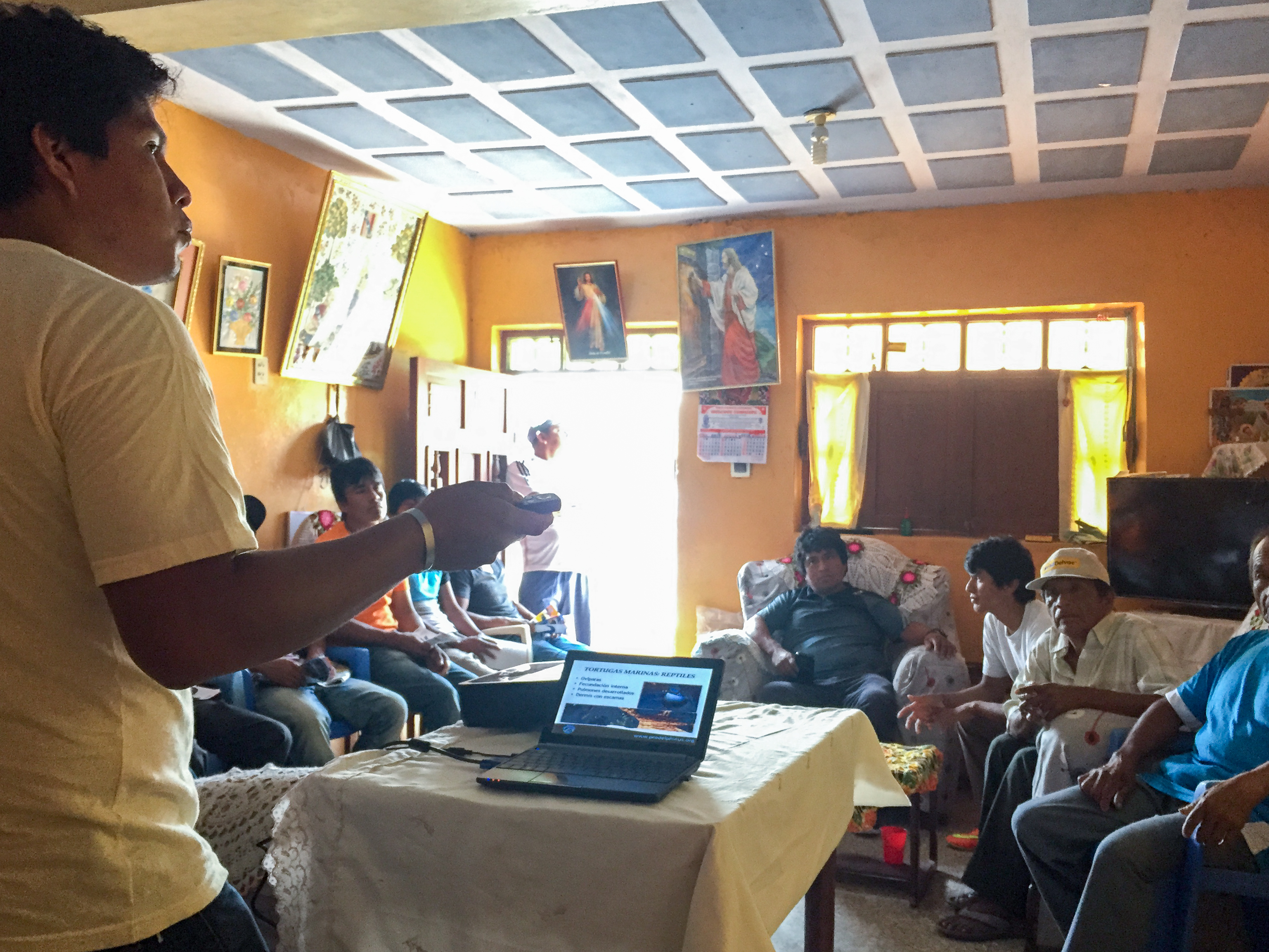
During the meeting with fishermen, Sergio gave a presentation on the biology and ecology of sea turtles, and techniques for freeing them from fishing nets.

During the meeting with fishermen, Sergio gave a presentation on the biology and ecology of sea turtles, and techniques for freeing them from fishing nets.

Over the next few days Sergio and Astrid took me around to fish markets, various government offices, and the fishers’ homes, where I got to informally ask them about their fishing and their environment, play with their children, and chat with their wives. Invariably the women would bring out some cake or plates of ceviche or a delicious fish dinner, and hours would go by as I mostly laughed vaguely at long fishing epics I only partially understood (so have I spent the majority of this week, alternating with furiously scribbling notes during jolting taxi rides). I’m blown away by the tremendous generosity of these families. They have running water and electricity for only a few hours each day, and yet wouldn’t hear of us ever eating in a restaurant. I’m grateful also that they’re already accustomed to talking with and trusting scientists–Pro Delphinus has done the hardest part for me through their years of wonderful and diligent work with these fishers.

We also visited two other northern ports, Constante and Parachiques, but only for a few hours.

We also briefly visited two other northern ports, Constante and Parachiques, and talked to people selling fish on the beach.

Once again, much is quite different–and much more complicated–than I expected. I have so much to think about: stories I see taking shape; inklings of ideas I’m excited to explore over the next month.

Santa Rosa fish market:

Santa Rosa fish market: “In Peru, the women work much harder than the men!”

I’m also taking a bit of time to wander along the Lima coastline, visit museums and galleries, eat unfamiliar fruits from sprawling markets, and partake in free outdoor salsa-Zumba. July isn’t Lima’s most photogenic month (it’s gray and clouded with sea mists every day, not unlike the California coast’s June gloom), but check out the photography page for some more pictures of my trip!